The Ryzen 7 9850X3D introduces marginal gains over its predecessor, appealing primarily to users on older CPUs rather than existing 7800X3D or 9800X3D owners.
The Ryzen 7 9850X3D, the latest entry in AMD’s Zen 5 X3D series, doesn't radically depart from its predecessor, the 9800X3D. Its standout feature, a boost clock of 5.6 GHz, marks an upgrade from the 9800X3D's 5.2 GHz, while maintaining a consistent thermal design power (TDP) of 120W. This improvement suggests enhanced efficiency and manufacturing yields from TSMC's 5nm nodes, paving the way for potential mid-cycle refreshes across the Zen 5 lineup.
| Specification | AMD Ryzen 7 9850X3D | AMD Ryzen 7 9800X3D |
|---|---|---|
| Cores / Threads | 8 / 16 | 8 / 16 |
| Max Boost | 5.6 GHz | 5.2 GHz |
| Base Clock | 4.7 GHz | 4.7 GHz |
| L2 Cache | 8 × 1 MB | 8 × 1 MB |
| L3 Cache | 96 MB | 96 MB |
| TDP | 120 W | 120 W |
| PPT | 162 W | 162 W |
| EDC | 180 A | 180 A |
| TDC | 120 A | 120 A |
| TjMax | 95°C | 95°C |
| Rec Cooler | 240–280 mm liquid (or equivalent) | 240–280 mm liquid (or equivalent) |
| Max Memory Speed (Non-OC) | DDR5-5600 (2×16GB) | DDR5-5600 (2×16GB) |
Benchmark Setup Analysis
To evaluate gaming performance, extensive benchmarks were carried out across seven titles at both 1080p and 1440p resolutions, prioritizing the highest quality settings with balanced upscaling. The testing environment employed high-end components to ensure that the CPU's capabilities were accurately assessed, eliminating GPU bottlenecking.
Test Setup
- Cooler: NZXT Kraken 420 Elite.
- GPU: NVIDIA GeForce RTX 4090 FE.
- Motherboard: Gigabyte Aorus X870E Elite X3D.
- Memory: Trident Z5 Neo 16 GB x2 @ 6000 MT/s CL30.
1080p Gaming Performance
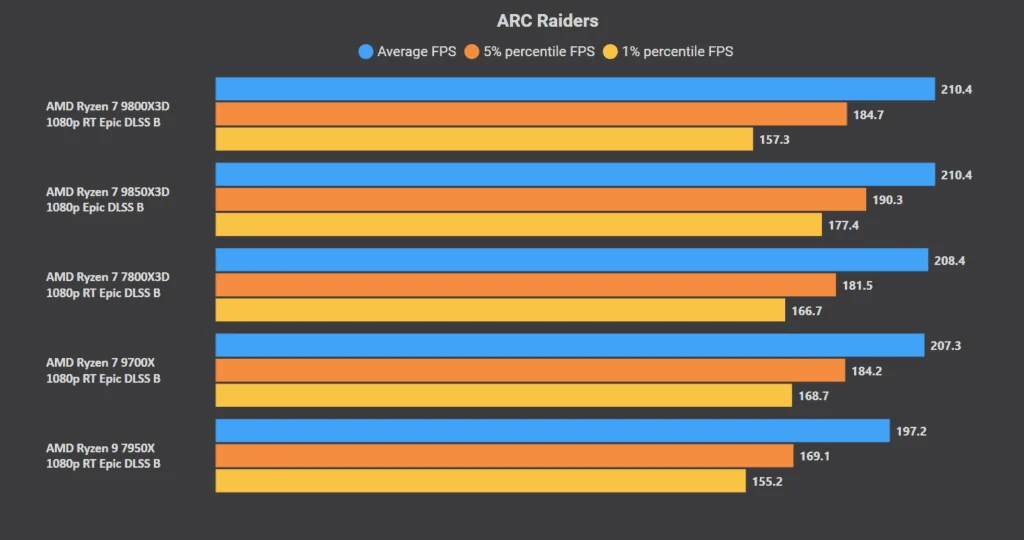
The 1080p benchmarks reveal noteworthy trends, especially under CPU-heavy conditions. If you’re aiming for smooth gameplay in demanding titles, you’ll want to pay attention to how each CPU stacks up:
- Performance among the Ryzen 7 series—specifically the 7800X3D, 9700X, 9800X3D, and 9850X3D—is tightly grouped, showing less than a 5% variation in numerous Unreal Engine 5 titles.
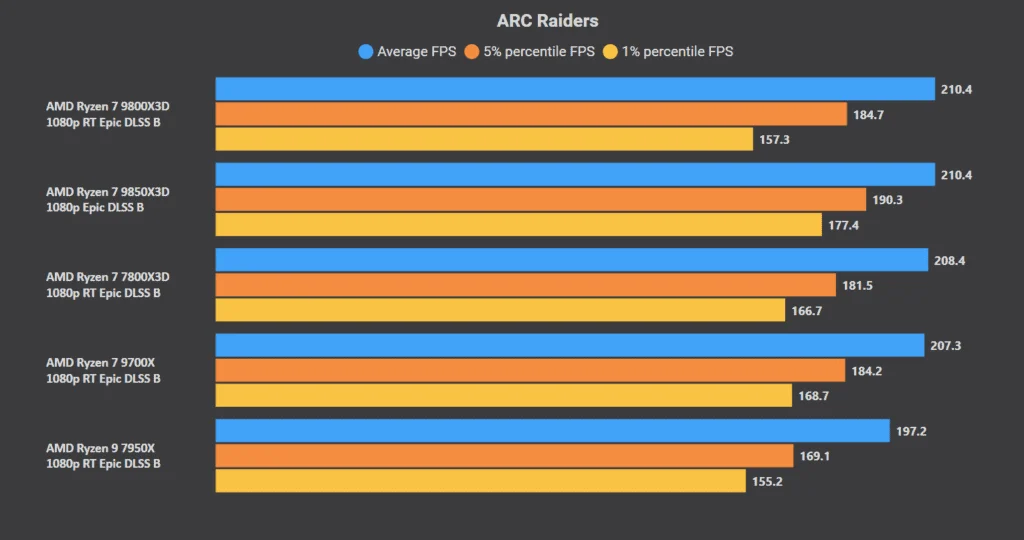
Titles like Battlefield 6 display a marked improvement from the Ryzen 9 7950X to the 9700X, yet the differences across the 7 series CPUs remain narrow, with the 9850X3D recording only a 2.3% advantage over the 9800X3D. This slight uptick suggests that while AMD is making strides, the returns are diminishing as the architecture matures.
1440p Gaming Performance
At 1440p, the performance variances tighten further. Here's the thing: the difference between the 9700X and 9800X3D narrows to just 2-4%, with the 9850X3D largely mirroring the 9800X3D's performance. The increasing resolution reveals more about the GPU's limitations than the CPU's capabilities.
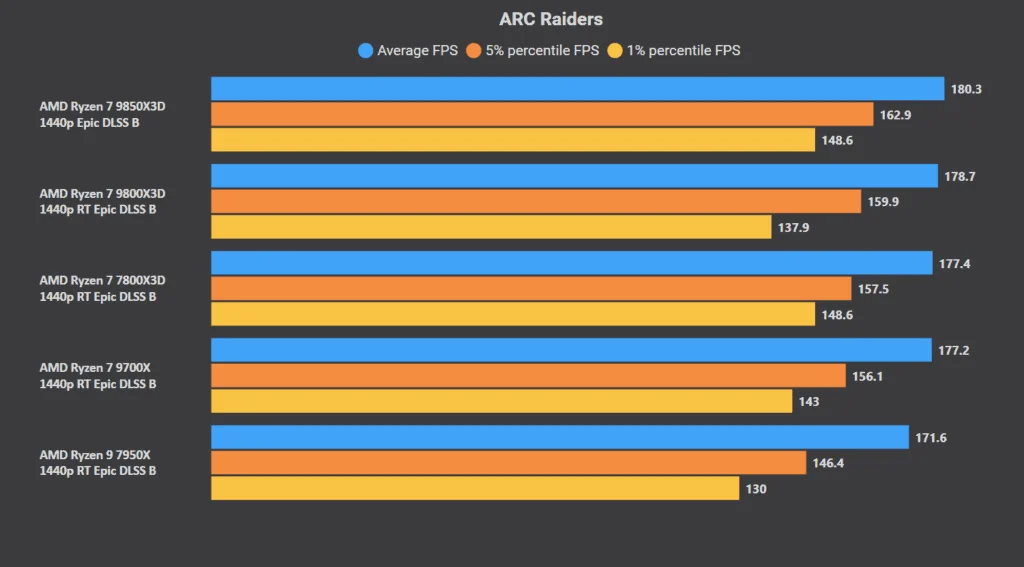
The tighter performance bands illustrate the increasing CPU-bound limitations as GPU demands rise, especially with titles that rely heavily on graphical fidelity. This means gamers will often find themselves bottlenecked by their graphics card rather than their CPU, leading to the question of how much more performance users can expect from just upgrading their processors alone.
Frame Pacing & Variance
Despite varied frame rates seen across the Ryzen 7 processors, overall frame pacing appeared consistent, providing a stable gaming experience even at 1080p. This stability is often overlooked but is integral to a pleasurable gaming experience—it's all about that smooth gameplay without interruptions.
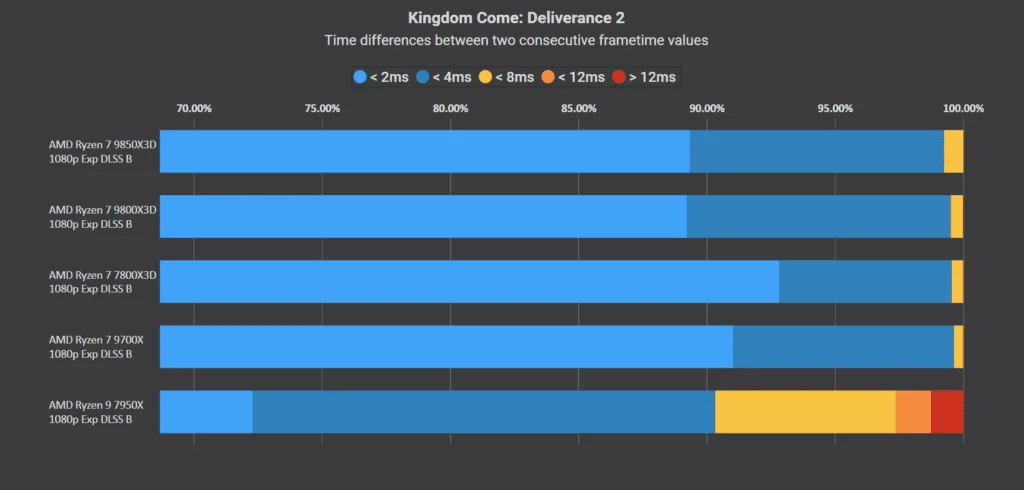
However, the Ryzen 7 X3D processors exhibited marginal gains over their predecessors in terms of frametime stability, particularly in demanding environments like Cyberpunk 2077, where frame variance has a noticeable impact on gameplay. This is more significant than it looks. In titles like these, the immersive experience can be heavily skewed by sudden drops in frame performance, affecting everything from in-game responsiveness to overall enjoyment.
Power and Thermals
While power consumption rose slightly with the 9800X3D and 9850X3D compared to the 9700X, it still remains competitive, even with a maximum of 129W under load. Effective cooling measures with a 420mm cooler kept temperatures comfortably under 70°C. Users can appreciate knowing that, even with the enhancements, AMD maintains a reasonable power output which is key for system stability and longevity.
Conclusion: A Minor Increment
The Ryzen 7 9850X3D serves primarily as a minor improvement over the 9800X3D. It's a compelling choice for those still on older platforms like the 7700X or 9700X. However, current users of the 7800X3D or 9800X3D might find little incentive to upgrade at this time.
Future Outlook and Implications
The insights gained from this review highlight how the Ryzen 7 9850X3D fits into AMD's shifting strategy, focusing on incremental enhancements to impress legacy users while maintaining a firm grip on performance for gaming enthusiasts. This approach isn’t unique to AMD; similar steps have been witnessed with competitors like Intel, who are also balancing innovation with stability in their lineups. For consumers, this means that unless you're currently on older hardware, the upgrade path may be less clear. You might be better off holding onto your existing setup or waiting for something that offers a more dramatic leap in performance.
This incremental refresh may serve specific segments, especially those looking to maximize their current setups without diving into a new platform entirely. But for those in high-performance gaming or content creation, the question remains: how long will AMD maintain momentum before larger changes come down the pipeline?
Discussion
Sign in to join the discussion.