The NVIDIA RTX 5060 outperforms the RTX 4060, delivering 25-30% faster performance across various games, especially in bandwidth-intensive scenarios.
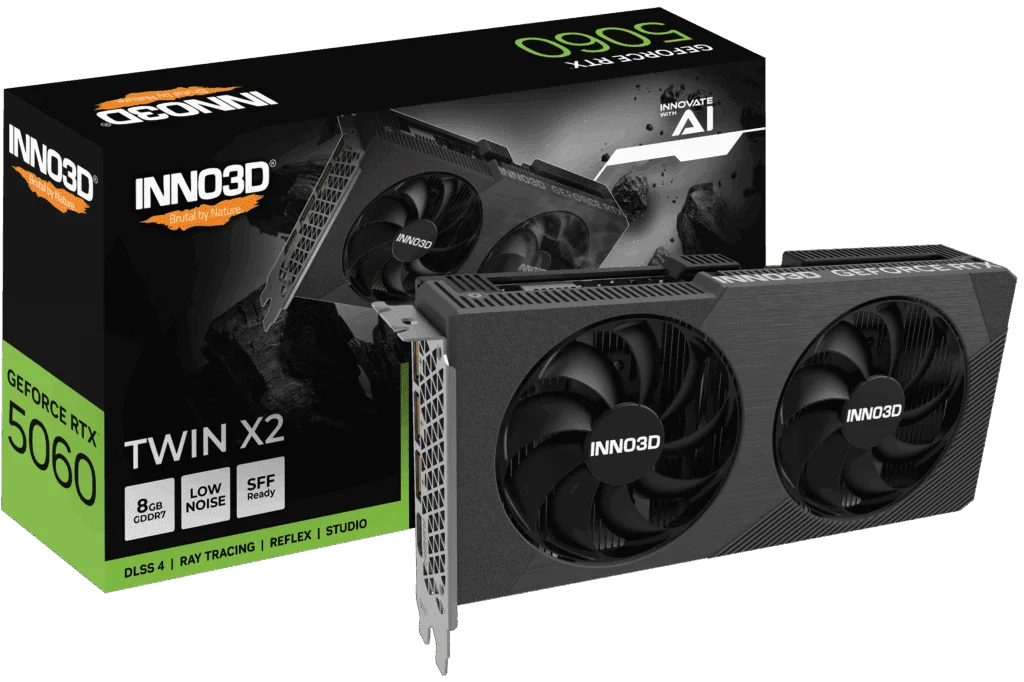
The anticipated GeForce RTX 5060 is set to challenge its predecessor, the RTX 4060, with significant enhancements that cater to serious gamers. The key difference lies in its upgraded GDDR7 memory, which positions the RTX 5060 as a strong contender in the mid-range GPU market. Here's a breakdown of the specifications:
| Specifications | MSI GeForce RTX 4060 Ventus | Inno3D GeForce RTX 5060 Twin x2 |
|---|---|---|
| CUDA Cores | 3,072 | 3,840 |
| Boost Clock | 2,490 MHz | 2,497 MHz |
| FP32 TP | 15.11 TFLOPS | 19.18 TFLOPS |
| Memory Type | 8 GB GDDR6 | 8 GB GDDR7 |
| Memory Speed | 17 Gbps | 28 Gbps |
| Memory Bus Width | 128-bit | 128-bit |
| PCIe Interface | PCIe 4.0 x8 | PCIe 5.0 x8 |
| Memory Bandwidth | 272 GB/s | 448 GB/s |
| TBP | 115 W | 145 W |
| MSRP | $299 | $299 |
Understanding the RTX 5060's Competitive Edge
The upcoming RTX 5060 looks poised to disrupt the mid-range graphics card market. Unlike its predecessor, the RTX 4060, which features GDDR6 memory, the RTX 5060's adoption of GDDR7 memory represents a significant leap in data transfer capabilities. This enhancement suggests much quicker access to data, which is particularly advantageous in high-intensity gaming scenarios where performance and speed are paramount. This is especially relevant for those gaming at higher resolutions or with advanced graphical settings.
Looking at the specifications, the increase in CUDA cores and memory bandwidth indicates that Nvidia aims to provide more than just incremental improvements. By boosting the performance metrics beyond the RTX 4060, the 5060 could set a new standard among mid-range GPUs. If you're working in this space, the RTX 5060 seems like one to keep an eye on, particularly as demanding titles continue to push hardware limits.
Benchmark Performance at 1080p
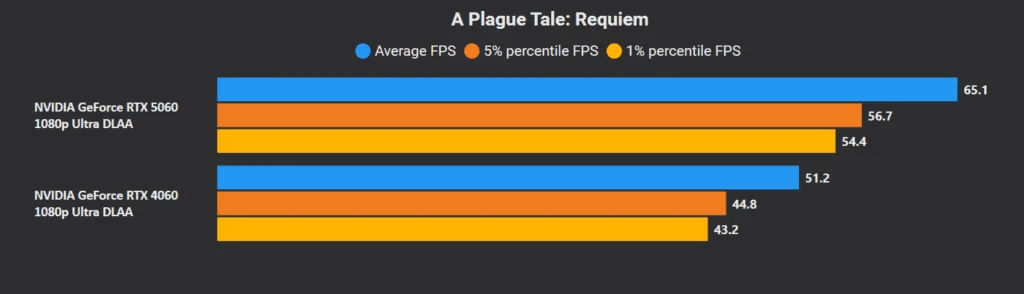
The performance difference between the RTX 5060 and RTX 4060 becomes evident in benchmark tests at 1080p resolution. Take "A Plague Tale: Requiem," for instance, where the RTX 5060 shows a remarkable 27% performance increase over its predecessor. This title's graphics memory demand remains modest, utilizing only 5-6 GB at maximum settings.
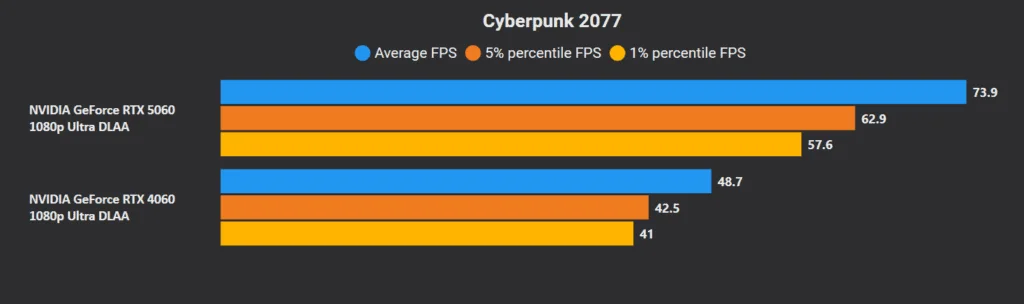
In contrast, "Cyberpunk 2077" showcases the RTX 5060’s bandwidth capabilities by outperforming the 4060 by an impressive 51% under similar settings. Here, both cards reach VRAM usages of around 6-6.5 GB. This performance delta largely underscores how modern games, particularly those heavy on textures and effects, can benefit from the upgraded GPU architecture.
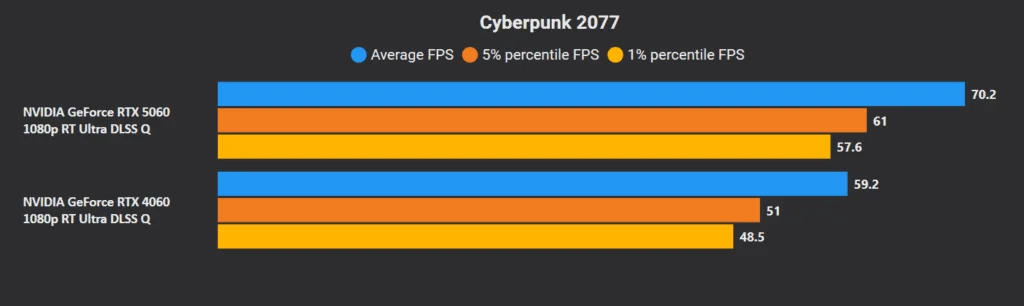
However, ray-tracing tests reveal a drop in lead for the RTX 5060, which only outpaces the 4060 by less than 20%. When you factor in path-tracing technology, this advantage diminishes to a mere 16%, despite achieving substantial frame rates aided by multi-frame generation techniques. This indicates that while the RTX 5060 makes strides in raw performance, it doesn't necessarily obliterate the competition in every computation-intensive scenario.
1440p Performance Assessment
Shifting to 1440p gaming, both the RTX 5060 and 4060 show limitations, often falling into unplayable frame rates due to either VRAM constraints or compute capacity shortages:
- Cyberpunk 2077 performs adequately here with upscaling but not without challenges. Ray-tracing and path-tracing push the GPUs to their limits.
- Indiana Jones & the Great Circle struggles at 1440p, averaging about 45 FPS on both GPUs, primarily due to VRAM congestion.
- Mafia: The Old Country experiences severe stuttering across the board at 1440p settings for both models.
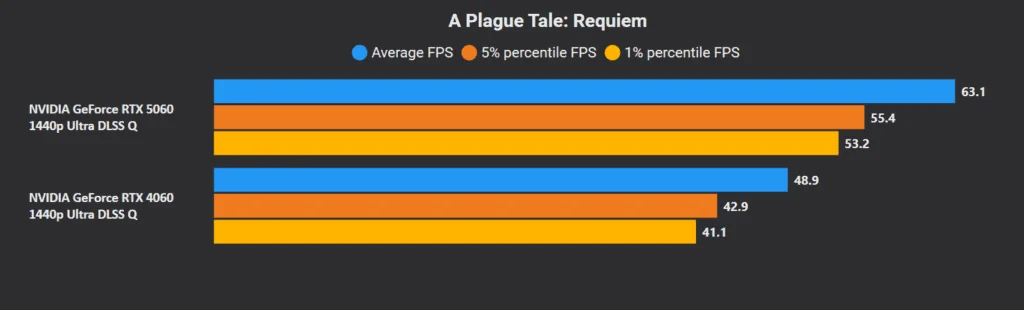
On the other hand, "A Plague Tale: Requiem" emerges as a standout, delivering 29% higher performance with the RTX 5060 at 1440p due to a manageable VRAM usage. This suggests that not all titles are created equal when it comes to GPU performance; some clearly benefit more from upgraded specs than others. (And this is the part most people overlook.)
Conclusion: Marked Improvements in Gaming Experience
- The RTX 5060 leads the RTX 4060 by 25-30% in performance across various titles, driven especially by bandwidth-hungry games.
- While limited 8 GB VRAM poses challenges to some newer titles, the RTX 5060 does achieve playable frame rates in demanding scenarios.
- However, new releases may require compromises on texture quality to maintain smooth gameplay in path-tracing settings.
As we approach upcoming releases, it will be crucial for gamers to assess their requirements against these two GPUs’ performance capabilities. With the landscape of gaming constantly shifting, having the right hardware might make all the difference in maintaining an optimal gaming experience. The release of the RTX 5060 isn't just an upgrade; it’s a pivot for many players defining their competitive edge in the market. The actual implications of these specs could influence purchasing decisions for many looking for capable devices in the current gaming environment.
Future Outlook: What Lies Ahead for Mid-Range GPUs?
Looking ahead, the competition in the mid-range GPU market is likely to intensify, especially with AMD's presence looming large. Gamers should brace for a cycle of technological advancements, particularly as new titles demand ever-more sophisticated hardware. Nvidia's decisions around driver updates, support, and pricing could also significantly affect how well the RTX 5060 performs in real-world scenarios. Long-term support and community engagement could very well dictate the card's success, as users increasingly rely on software optimizations to stretch hardware capabilities.
In the end, if the RTX 5060 can maintain its competitive edge in benchmarking, alongside consistent driver support, it may herald a new era of mid-range gaming experiences. With the right strategies, Nvidia could solidify its position as a dominant player even in an increasingly crowded market.
Discussion
Sign in to join the discussion.